
What Marvel Can Teach Us About Moving With The Times
The Business That Nearly Disappeared
It is hard to imagine now, but Marvel was once dangerously close to disappearing.
Today, Marvel feels almost unavoidable. Its characters are on cinema screens, streaming platforms, theme park rides, lunchboxes, T-shirts, video games and pretty much every corner of popular culture.
But in the mid-1990s, the business behind Spider-Man, X-Men, The Avengers, Iron Man and the Fantastic Four was in serious trouble.
In December 1996, Marvel filed for bankruptcy. By October 1998, it had emerged from bankruptcy, but the company was a long way from the entertainment powerhouse we know today.
The business had been built on comic books.
That was the core product. That was the format people associated with Marvel.
But the world around it had changed.
When The Format Was No Longer Enough
Comic book collecting had boomed, then crashed.
The market became oversaturated. Readers moved on. Retailers struggled. What had once felt exciting and valuable began to feel niche, dated and uncertain.
The characters still had value.
The stories still had value.
The emotion, imagination and mythology still had value.
But the format was no longer enough.
And that is the important bit.
Marvel was not saved by abandoning what made it special.
It was saved by finding new ways to make what made it special matter again.
Marvel Was Bigger Than Comic Books
The company began to understand that it was not simply in the comic book business.
It was in the character business.
The story business.
The imagination business.
That shift changed everything.
Before Marvel built its own cinematic universe, it started to see what was possible by letting its characters live beyond the page.
One of the first major signs came in 1998 with Blade.
Based on a lesser-known Marvel character, Blade was not the obvious blockbuster bet. It was darker, sharper and a world away from the colourful superhero films people might have expected.
But it worked.
The film became a success and proved that Marvel’s characters did not need to stay trapped inside comic books to have value. They could move into cinema, reach new audiences and still carry the same core appeal.
Then came more mainstream successes.
X-Men arrived in 2000.
Spider-Man followed in 2002.
Those films helped bring Marvel characters to mainstream cinema audiences who may never have walked into a comic book shop.
But even then, Marvel was still mostly watching other studios build value from its characters.
Then came the bigger move.

The Risk That Changed Everything
In 2005, Marvel launched its own independently financed film slate through a $525 million credit facility.
This gave Marvel greater creative control, greater profit potential and the ability to build its own film library, rather than simply handing characters to other studios and taking a smaller slice.
That was a huge risk.
Marvel did not have all of its most famous characters fully under its own control.
It did not have Spider-Man.
It did not have the X-Men.
It did not have the Fantastic Four.
So instead of leading with the obvious names, Marvel had to build around characters that, at the time, were far less proven on the big screen.
One of them was Iron Man.
Before 2008, Iron Man was not the global icon he became afterwards.
He was known to comic fans, but he was not a guaranteed mainstream hit.
The casting of Robert Downey Jr. was seen by many as a risk. The idea of Marvel becoming its own film studio was a risk.
The whole thing was a risk.
But it worked.
Iron Man became the launchpad for what would become the Marvel Cinematic Universe.
That success did not make the comics irrelevant.
It made them more valuable.
Innovation Made The Core Stronger
The films gave the characters new life.
They brought new audiences into the world.
They made decades of stories feel current again.
They turned back-catalogue characters into global brands.
And that is the point every business should pay attention to.
Innovation does not have to mean walking away from your core offer.
Sometimes, it means finding a better way to deliver it.
Sometimes, it means taking what people already love about you and placing it somewhere more relevant, more accessible or more valuable.
Marvel’s core product was never really paper and ink.
It was heroes, villains, conflict, identity, emotion, transformation and story.
Comic books were just the format.
Once Marvel understood that, the business changed.

The Same Lesson Applies To Every Business
The same applies to almost every brand.
A fitness coach is not really selling sessions. They are selling confidence, structure, accountability and progress.
A restaurant is not just selling food. It is selling atmosphere, memory, service and a reason to return.
A branding agency is not just selling logos, websites or campaigns. It is selling clarity, confidence, direction and commercial value.
The danger comes when businesses confuse the format with the value.
They think, “This is what we sell,” when the better question is:
“Why do people actually buy this?”
Because once you understand the real value of your offer, you can start to evolve it.

Evolve The Offer, Not The Soul
That might mean adding a new service.
It might mean packaging your expertise in a different way.
It might mean turning a one-off product into a retained service.
It might mean creating digital tools, content, training, subscriptions, events, consultations or experiences around the thing you already do well.
Not for the sake of doing something new.
For the sake of staying relevant.
Marvel did not become more valuable by shouting louder about comic books.
It became more valuable by turning its characters into a wider universe.
The core became stronger because the offer evolved around it.

Standing Still Is Not A Strategy
If you stand still for too long, the market moves without you.
Customer expectations change. Technology changes. Buying habits change. Attention moves elsewhere.
You can have a brilliant product and still become irrelevant if the way you package, position or deliver it no longer fits the world around you.
Moving with the times does not mean chasing every trend.
It does not mean watering yourself down.
It does not mean becoming something you are not.
It means knowing the difference between what is sacred and what is simply familiar.
Your purpose might be sacred.
Your standards might be sacred.
Your customer promise might be sacred.
But the format? The delivery? The packaging? The route to market?
Those things should be allowed to evolve.
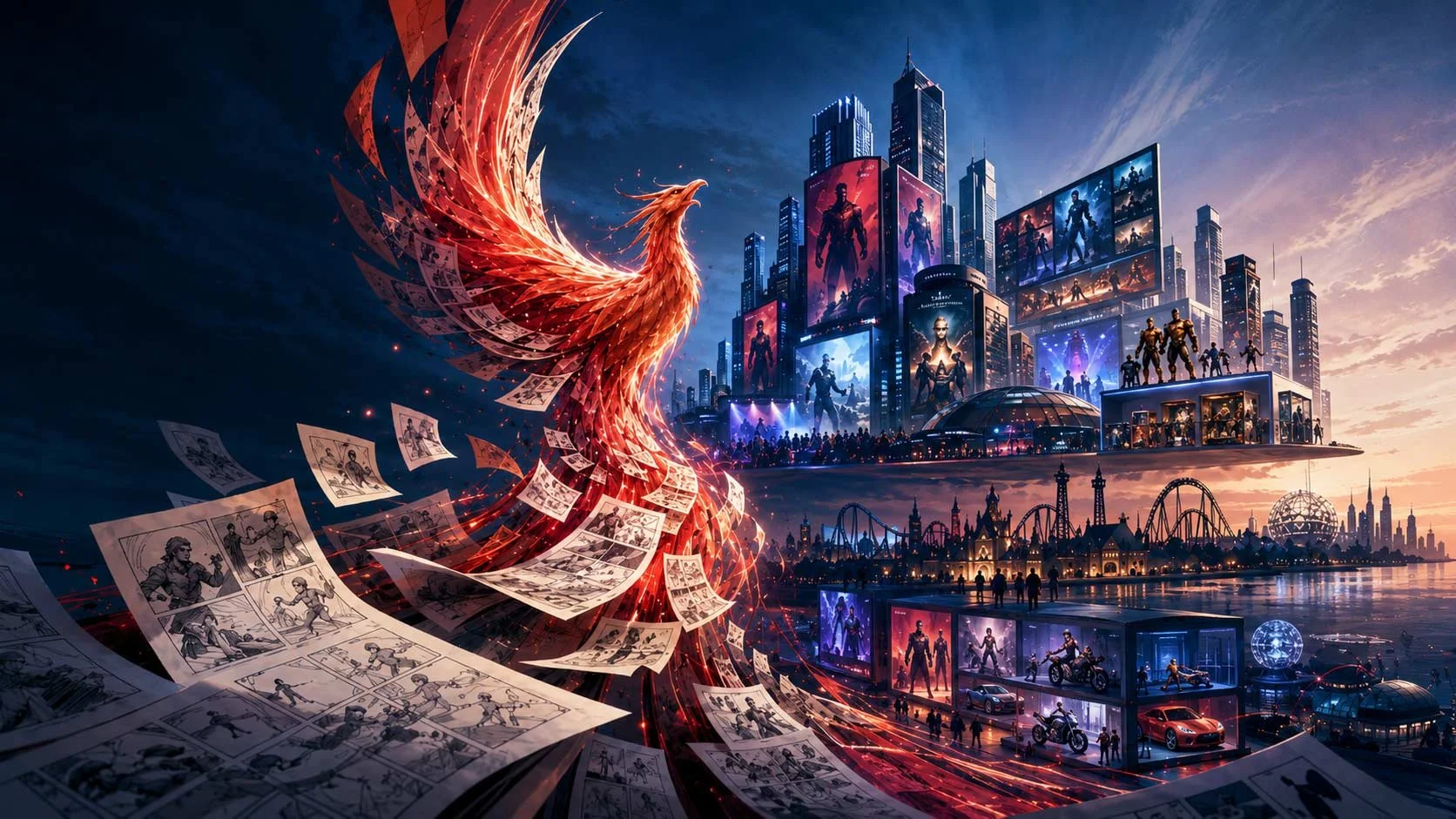
The Real Marvel Comeback Story
Marvel’s comeback is often described as a film story, but really, it is a business story.
It is about recognising hidden value.
It is about having the courage to rethink the offer.
It is about understanding that your strongest asset may not be the thing you sell, but the reason people care about it in the first place.
By 2009, Disney agreed to acquire Marvel in a deal valued at approximately $4 billion.
That value was not built around comic books alone. It was built around Marvel’s global brand, its library of characters and the ability to maximise those creative properties across multiple platforms.
That is what happens when a brand evolves properly.
The original offering does not disappear.
It becomes part of something bigger.

The Question For Your Business
So the question is not whether your business should change.
The question is what should stay the same, and what needs to evolve around it?
Because standing still might feel safe.
But as Marvel nearly found out, safe can be the most dangerous place to be.
FAQs
Did Marvel nearly go out of business?
Yes. Marvel came dangerously close to going out of business in the 1990s and filed for bankruptcy in December 1996. At the time, the comic book market had crashed, the company was under financial pressure and its future looked uncertain.
What caused Marvel’s financial problems?
Marvel’s problems were largely caused by the collapse of the comic book boom, oversaturation in the market, falling sales and heavy debt. The brand still had valuable characters and stories, but the business model around comic books was no longer enough on its own.
How did Marvel recover?
Marvel recovered by rethinking the value of what it owned. Instead of seeing itself only as a comic book company, it began to build value around its characters, stories and intellectual property through licensing, films and eventually its own connected movie universe.
Did movies save Marvel?
Movies played a huge role in Marvel’s comeback, but the deeper lesson is that Marvel did not simply move into film. It found a new way to deliver the value it already had. The films made Marvel’s characters more accessible, more relevant and more valuable to a much wider audience.
Why was Iron Man so important to Marvel’s comeback?
Iron Man was important because it launched the Marvel Cinematic Universe in 2008. At the time, Iron Man was not Marvel’s most obvious mainstream character, which made the film a risk. Its success proved that Marvel could turn lesser-known characters into global icons when they were positioned and delivered in the right way.
What can businesses learn from Marvel?
The biggest lesson is that businesses need to move with the times without losing what makes them valuable. Innovation does not always mean replacing your core offer. Sometimes, it means finding a better, more relevant way to package, position or deliver it.
How can innovation make a core offer more valuable?
Innovation can make a core offer more valuable by opening it up to new audiences, new formats and new opportunities. Marvel’s films did not make the comics meaningless. They made the characters, stories and original source material more valuable by giving more people a reason to care.
What is the main message of Marvel’s comeback story?
The main message is that standing still is risky. A business can have a strong product, a loyal audience and a valuable brand, but if it does not evolve with the market, it can still get left behind.
NEED OUR HELP?
Whether it's Branding, Design, Websites, Photography, Video, Print or Social Media, we can help you make an impact.